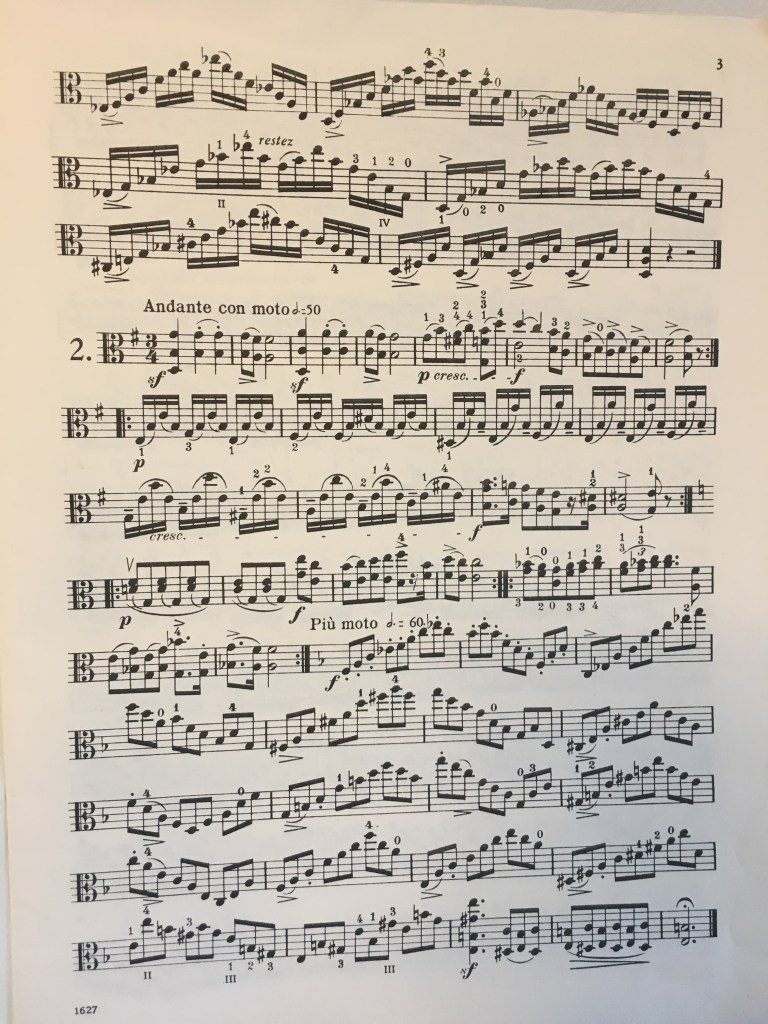
Campagnoli, Caprice no. 1

Reflections on practicing the first of Campagnoli’s Caprices

At long last I am ready to share my initial thoughts after delving into my self-imposed boot camp of Campagnoli Caprices. The first thing we see when we open the book is a part-preface, part-manifesto by William Primrose, who edited this transcription. An apt warning for challenges ahead, its rather sassy tone still delivers a meaningful point :

“In re-editing these unique and highly original works by Campagnoli I have approached the task from the point of view of what I like to believe is that of the ‘present day’ violist. Departed are the times when a violist was regarded as one who could no longer make the grade as a violinist and, rather than relegate the unfortunate to the trash heap of unwanted things, he was, out of pity and charity, demoted to the alto section of an orchestra otherwise sound in body and spirit! Earlier editions of the Campagnoli studies, with one exception, appear to me to have reflected such evil times and it was with some justification, I feel, that in this one I present the contemporary student with a somewhat exciting challenge, musically and technically. The fingerings, I dare to think, explore the realms of the virtuoso and are not so much a means to an end as an and in themselves. In turn, if properly surmounted, the difficulties encountered will lead to a more musicianly approach than the earlier ‘safety first’ methods evoked.”

I must admit that I adhere all too often to the “Safety First Methods” to which Mr. Primrose alludes, and that much of my recent self-criticism is related to my unwillingness to use more interesting fingerings in orchestral settings. It is part of the job to be aware of the fingerings your colleagues are using, and sometimes even if it isn’t written in the part to do so, if the others are generally using up-the-string fingerings it will make the section sound worse, not better, to opt for first position. Despite knowing this, I still fight a very strong propulsion to chicken out, play the fingering I know I will not mess up, and choose what I see as the lesser of two evils.

So, I’m going to face the problem head on. Without further adieu, let’s dive into the discomfort zone with Caprice no. 1.

Caprice no. 1 in C minor
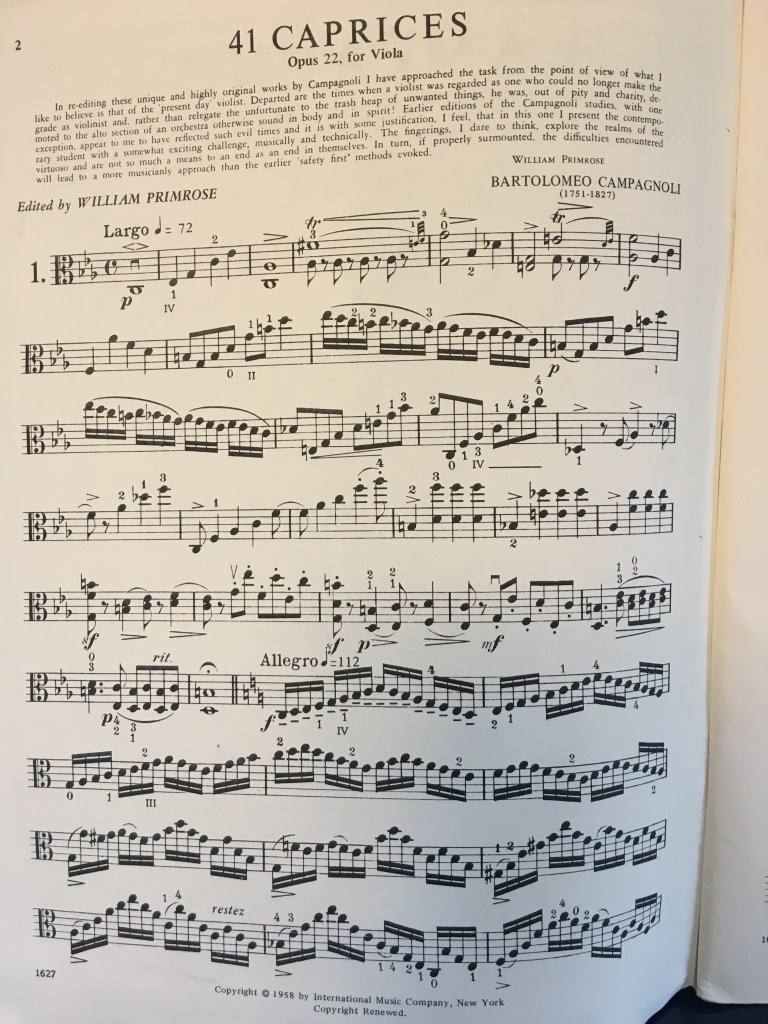
The Largo begins in the particularly resonant key of c minor. Immediately the fingerings are, as we were warned, more creative than strictly necessary and as a whole the entire introduction could be very easy but is made pleasantly challenging simply by the fingerings. In addition to the obvious challenge of playing notes in tune, the sul c lines were especially helpful in helping me realize how much I’ve been ignoring my bow arm on the c string. In fact, with sul c and sul g passages the bow is just as crucial as the left hand in deciding whether something will sound in tune. I’ve found that my left hand might reach the note successfully but my right hand has to change, often in speed or in contact point, in order for it to sound correct. I’m more conscious now of how much arm weight is required to get the c string to vibrate at all, let alone to keep it vibrating consistently and with musical intent.

The end of the introduction also uses some constricted half-step fingerings that are quite unusual. using fingers 1,2,3 and 4 all within four half steps of each other is something of a tongue twister and has been a good workout for my brain to make sense of. I can see this type of fingering coming in handy for alternating double-stop sixths that have no other solution, so I’m happy to work this into my toolbox of fingerings.

The Allegro section, a series of seemingly simple scales and arpeggios, is also made much more challenging with up-the-string fingerings. Detaché strokes indicate even more clearly whether I’m using my bow efficiently on the lower strings; more bow changes create more chances to unintentionally change the sound, to fail to catch the string correctly and get unintended overtones. Going up a string, making it dramatically shorter, also increases the chance of this. Similarly to how there’s an optimum bow speed, bow weight and contact point for each open string, there’s another set of all of these things corresponding to each upper register of each string.

Luckily, we have 40 more caprices filled with opportunities to refine our upper-register technique.

Additional challenges of this Allegro section include string crossings in the arpeggiated section, coupled with more adventurous leaps into the upper positions. Arpeggiated passage work always gives me a sense of short-term dyslexia and it’s challenging just to get through the passage at a quick tempo without any lapses in confidence. It’s one thing to practice passage work and get it up to tempo while also internalizing the patterns, which anyone can do, and quite another to sight read it, taking in as much information as possible immediately. Reading as I play, keeping one eye on what I’m playing and one on what’s coming up, is also a skill I’ll refine very much doing passages like this.

One last thought about this first caprice is that I appreciate the fact that we began in the key of c (and eventually C). This is the friendliest key to viola players and, since our open strings all resonate in this key and our lowest one is the tonic, hearing whether something is in tune is easier than in any other key. I can tailor my intonation to the instrument; if the instrument “likes” the pitch it will resonate much more than it does when the pitch is slightly off. In keys like C there are also many opportunities for natural harmonics, which Mr. Primrose made good use of here in this introduction, and these also provide benchmarks as I travel up the string, checking if the stopped notes are in agreement with the harmonics around them.

This caprice ends in a satisfying dominant cadence relative to the second caprice, so they could be played in immediate succession as one Mega Caprice. But my arm needs a rest from all those sul c and sul g’s, so we’ll save Caprice 2 for another day!

The Etude Challenge: Re-Discovering my Technical and Creative Confidence

The life of a London orchestral player is fast-paced and stressful, stretching one’s sight reading and quick-processing skills to the limit in order to handle more concerts, on fewer rehearsals, than any other orchestral scene on Earth. While a career of sprints develops a unique skill set in musicians here, a hectic schedule of short-term and urgent preparation for individual performances can exhaust us. While a few seasons can cram a remarkable amount of specialized repertoire into our heads, it is all too easy to lose one’s own perception of sound production, technique, and creativity. Certainly our love of playing can also diminish as it becomes intrinsically linked with daily work and one-shot performances. Making time for practice, particularly for the sole sake of personal improvement, can be difficult if not impossible without sacrifice.

In the past few months I have felt this loss of focus very deeply. As my schedule becomes more demanding than ever before, which of course has its rewards, I am at risk of losing my technical precision, my adventurousness, and my love of solo playing due to my own time management. 

In order to counteract this, I’ve made a pact to learn an entire book of solo studies, or Etudes. Perhaps more than one book, but I will begin with Bartolomeo Campagnoli’s book of 41 Solo Caprices, transcribed from violin to viola by William Primrose.

I’ll take as long as I need to work through each one, in order to regain my technical confidence and with it my love for producing my own unique sounds and creative ideas. So far, I’ve done four, and already I am seeing a marked improvement in my upper position technique, sound production in high positions and on low strings, and control of tone color. I’m even noticing an increased variety of tone colors I can produce, which widens my repertoire of sounds from which to draw and helps me better express particular ideas in each phrase.

I’m holding myself to higher technical an musical standards than I ever have, and this is reviving my love of my instrument and the time I spend playing it.

In my future articles I will reflect on my experience with each of the etudes I am studying. I hope that my reflections will serve as useful tools for students and clarify my own vision of how to best teach etudes and studies, which can seem boring and tedious but are invaluable tools in synthesizing technique with creative intent.

Tune in next week for Caprice no. 1, which explores the viola’s most resonant key of C.

Quality, quantity and frequency of practice

Both children and adults in our modern age are experiencing increasing competition in all aspects of life. Overwork can destroy our love for our hobbies; music can easily become one of the chores we are doing and the frustration is bound to build inside us. Reflecting on these simple questions may help you find a positive relationship with your practice sessions.

How much should I practice?

I remember times in high school when we compared how many hours we practised each day as if it was a competition. While peer pressure can be a good motivation it is important to take it with a pinch of salt. Practising too much will increase the risk of injury and likely build tension. A certain quantity is needed to improve, but quality still prevails, especially over physical injury and mental stress.

Is my practice quality practice?

Quality practice is a broad term and each individual should search for it’s appropriate definition. No matter where we are in our musical progress the quality can always be improved. Organising your practice in advance and knowing the goal of each session will give you direction. The goal should be specific and achievable by the end of the session—so, instead of “fix my intonation” which will take a lifetime, think on the scale of “isolate all pitches on third finger and reinforce the correct position of it.” By doing these organised increments of practice combined with breaks you can maximise your productivity during a session. Less is only more when less is more efficient.

How frequently do I practice?

Remember that cramming is not proper practice. Learning something last minute might save us before a lesson or an exam we’ve been dreading, but it won’t encourage long term improvement and motivation. Try to find regular occasions when you can delegate a fixed amount of time and form a habitual pattern. The best way to achieve that is to incorporate the practice session between two activities that you are doing regularly – for example, coming home from school or work and eating dinner.

Why do I practice?

While answering this can be simple for activities in the near future it is important to look at the bigger picture and search for long term goals, such as performing a piece for our friends in couple of months, prepare for an entrance audition or play at a local community centre. Looking further in advance will encourage us to invest time daily and secure the achievement on a long term goal. Setting performance opportunities in the not-too-near future will provide excellent motivation and exercise our goal-oriented practice planning.

Practice Series for Strings: Warmups

Taking you through a successful practice session, one step at a time

You’ve finally set aside the time to practice—no easy feat amidst all the commitments we have to our work, our peers and ourselves. Congratulations on choosing a rewarding and creative commitment to add to your schedule; you won’t regret it! Now, let’s make sure you get the most out of this session for which you’ve sacrificed your time.

Unsurprisingly, all good practice sessions are planned. If you take advantage of the incredible human affinity with patterns and habits, you can make each practice session structured and rewarding. We all have days when, although we know we should practice, we just don’t feel motivated. Forming strong habits can help us work through these days; even just by doing our usual warm-ups, we can convince the body and the mind to get on with it and suddenly, we’ve achieved our full practice session with minimal suffering. Given this power of the first step, a strong warmup routine is perhaps the most important aspect of practice sessions.

Designing an Effective Warmup

Whether today’s session will be fifteen minutes or three hours, you can get the most out of it with these tips:

  • For short sessions, budget about 1/5 of your practice time for a warmup. For sessions longer than an hour, budget about 10 minutes.
  • Focus on only two things: physical comfort and good sound production. The entire body, especially both hands and both shoulders, should feel comfortable.
  • Begin making sound on the instrument in the simplest way possible, so as to keep your mind only on these two aspects. This encourages your brain to link good sound with relaxed muscles, not tense ones.

Now on to the specifics. As a string player I will write from my biased perspective, and let Jernej offer a woodwind perspective in a separate post.

The Everyday Warmup

This can be altered to take more or less time. Once you finish the initial warmup you can repeat it with focus on relevant techniques like pitches and shifts, depending on time.

  • Stand with comfortable, tall posture. Shoulders roll back and downward as far as is comfortable.
  • Instrument in playing position, bow in hand with a good bow hold. Check in once more to ensure you’ve remained relaxed despite holding the instrument.
  • Begin with 10 (or 5, if time is tight) long bows on the highest open string, all the way from the frog to the tip (or as much as your arm can straighten comfortably which might not necessarily be all the way at the tip!)
  • Repeat these long bows on each string, in order, noticing that the arm gets heavier, the bow goes slower, and it comes closer to the bridge in order to produce the same healthy sound on the lower, thicker strings.
  • Do your best to keep the sound exactly the same quality and volume for the entire bow, all 10 repetitions, on every string.

Is that really it?!

Yes! There are many variations you could add to this basic structure, but this is the starting point. This warmup should take some time and you should finish feeling like you’ve focused quite intently. By bringing your brain into deep focus, but not for so long that it is exhausted, you will feel “in the zone” enough to move on to the next step: scales. Believe me, if we use too much effort on the warmup we’ll never make it through scales, which build on the sound production we’ve worked very hard to achieve here but add the enormous distraction of notes. While you’re still not using left hand technique, appreciate the time to focus just on your right hand, which is your voice as a string player. In many ways the right hand is more important than the left!

And with that, happy warmups from LGMS!

Chipping away: Practice Takes Patience

Coming to terms with the slow process of learning and seeing the result of your work.

Choosing to take private music lessons is an investment not only of finances but also of time. Aside from the hour each week spent with the tutor, you are then responsible for reviewing the lesson concepts each day on your own. Studies show that physically complex dexterity like playing music can take up to 400 repetitions to create a single new synapse in the brain! So, associating a certain finger to a pitch, or getting a feel for what part of the bow is most suitable for bouncing on the string, will take time.

Although it is daunting to think of the commitment required to build habits, we can take comfort in that fact too. If something doesn’t seem to be better overnight, or things that improved in one practice session seem to regress when you pick up the instrument again, this is normal. Seeing our own improvement might take several weeks or even months, but when we see it, the sense of achievement is worth the effort and encourages us to do more.

Try keeping a journal of your practice sessions. Write short notes about what you have worked on, and see how the journal fills after just a week, a month and a year of work. If you ever doubt your ability to reach a goal, music or otherwise, you can take heart in your ability to commit by looking at a well-kept practice journal.

If you’ve played for long enough to have several pieces of repertoire under your belt, try going back to a piece you haven’t played in a while. You’ll be surprised how much easier it seems and how the sections that used to be difficult probably aren’t nearly so now. Though it’s difficult to see one’s day-to-day improvement, a month or a year’s worth of work will show immediately when you take out an old study form that time.

Finally, make sure to perform. If you have no platform for that, use a smartphone or a mini recorder record yourself performing in your home and watch it. All your worst habits will come out when you’re nervous, and you’ll discover many things you didn’t know you did, both good and less so. Are your movements helping or hurting the music? Is your shoulder tensing up? Do you tend to use much more or less bow than you thought? Focusing on these “invisible” habits can make your improvement much quicker, and when you record yourself again you will see visible progress. Having a bank of recordings also means you can go back and see old recordings of yourself when you wish to, especially on days when you are feeling discouraged. 

Building any habit takes time, so a series of complex habits like playing an instrument can be a lifelong commitment, but it’s worth that feeling of achievement when we see our work leading to real improvement. Any aspect of our life can improve when we exercise this type of discipline.

And with that, happy practicing!